
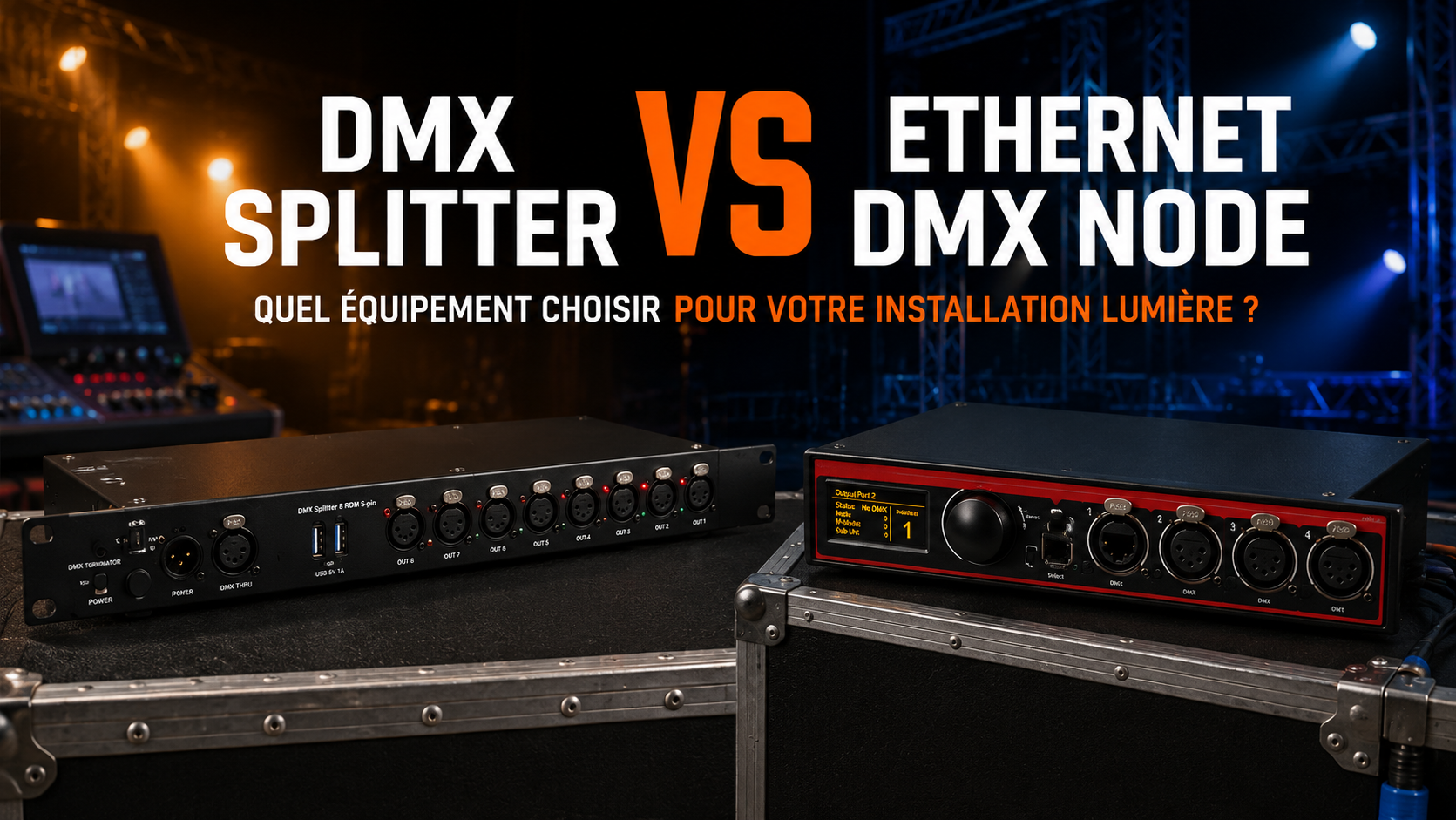
DMX splitter, Ethernet node, Art-Net, sACN, DMX universe... As soon as a lighting setup starts to grow, it becomes easy to confuse the roles of these different pieces of equipment.
However, the difference between a DMX splitter and an Ethernet/DMX node is quite simple.
A splitter is primarily used to distribute and isolate an existing DMX signal.
A node is used to convert Art-Net or sACN network data into physical DMX outputs.
And in a professional setup, the two are often complementary.
Let's start with DMX
A DMX512 universe can carry up to 512 channels.
For a small setup, that's more than enough. You can start from a console, enter the first fixture, then move on to the next, and so on.
This is called daisy chaining.
But when fixtures start to be spread across several areas of the stage, this method quickly becomes impractical.
This is where the splitter comes in.
What is a DMX splitter used for?
The principle is simple: a DMX splitter receives a DMX signal and duplicates it to multiple outputs.
If you input universe 1 into an 8-output splitter, all eight outputs will still transmit universe 1.
Therefore, the splitter does not create any additional universes.
Its benefit lies elsewhere.
It allows a DMX line to be divided into several independent branches and, when it is a true opto-isolated splitter, also provides electrical isolation between the different lines.
Why is this isolation important?
On a stage, fixtures are not necessarily powered from the same electrical circuits, and cable lengths can become significant.
Isolation helps limit the propagation of certain electrical faults and reduces problems related to potential differences between equipment.
Another advantage: if one DMX branch encounters a problem, the other lines are more likely to continue functioning normally.
This is why splitters remain extremely useful, even in modern installations using Art-Net or sACN.
The splitter mainly helps organize cabling better
Imagine a stage with several zones:
- a line for ceiling fixtures;
- a line for stage left sources;
- another for stage right;
- a last one for the set.
Without a splitter, you would sometimes have to build a long DMX chain passing successively through all these zones.
With a splitter, you can start from a central point and distribute several independent lines.
It's much cleaner and, more importantly, much simpler to troubleshoot.
So, what is an Ethernet/DMX node used for?
The node addresses a different problem.
As soon as an installation uses multiple DMX universes, carrying each universe with its own cable quickly becomes impractical.
This is precisely the benefit of network protocols like Art-Net and sACN.
Instead of directly transmitting the DMX512 signal over an XLR link, DMX information is encapsulated in an Ethernet network.
A single network can thus carry many universes simultaneously.
The node then acts as a gateway between these two worlds.
Ethernet → Node → DMX
The node receives the Art-Net or sACN universes present on the network and converts them into physical DMX outputs usable by the fixtures.
Example with a 4-port node
Let's take a node equipped with four DMX outputs.
We could configure:
Port 1 → Universe 1
Port 2 → Universe 2
Port 3 → Universe 3
Port 4 → Universe 4
We then have four independent universes, totaling up to 2,048 DMX channels.
However, the ports are generally not required to follow each other.
Depending on the node used, you could very well have:
Port 1 → Universe 1
Port 2 → Universe 8
Port 3 → Universe 20
Port 4 → Universe 42
This is a fundamental difference from a splitter.
On a splitter, all outputs replicate the same signal.
On a node, each output can receive a different universe from the network.
Art-Net and sACN: why use Ethernet?
The main advantage is not simply having "more channels".
It's primarily about being able to transport a huge amount of information over a standard network infrastructure.
Imagine a control room located several tens of meters from the stage with eight universes to transport.
In traditional DMX, this could mean eight long DMX lines.
With a network architecture, a single Ethernet or fiber link can carry all universes to the stage.
Once near the fixtures, one or more nodes convert the network data back into physical DMX.
This is particularly useful for studios, large film sets, complex LED installations, touring, and centralized lighting control systems.
So, should splitters be replaced by nodes?
No.
And this is probably the most important point to understand.
A node and a splitter do not serve the same function.
In many professional installations, both are used.
The network is used to transport multiple universes over long distances, and splitters then distribute each universe locally.
Hybrid architecture: often the most logical solution
Let's take an example.
The lighting console sends several universes in sACN or Art-Net over the network.
An Ethernet or fiber link carries this data to the stage.
A network switch then distributes the signal to different nodes.
A node located near the set, for example, receives four DMX universes.
One of its outputs can then be sent to a splitter which distributes this universe to several groups of fixtures.
This results in:
Console → Network → Switch → Node → Splitter → Fixtures
This architecture combines the advantages of both technologies.
The network efficiently transports multiple universes over long distances.
The node selects and converts the universes needed.
The splitter then handles local DMX distribution.
What about RDM in all this?
RDM (Remote Device Management) allows bidirectional communication between the controller and compatible devices.
Unlike classic DMX, where information primarily flows from the console to the fixture, RDM also allows the fixture to send back certain information.
Depending on the equipment, you can remotely modify a DMX address, identify a device, or consult certain parameters.
But for this to work throughout the entire chain, the intermediate equipment must also properly manage RDM.
If you want to use this function, check the RDM compatibility of both the node and the splitter.
Beware of the network
A DMX splitter is generally very simple to use:
plug it in, and it works.
A node requires a minimum of network knowledge.
IP address, subnet mask, Art-Net, sACN, multicast, universe configuration... a misconfiguration can quickly cause behaviors that are difficult to diagnose.
In large installations, the lighting network must therefore be considered a real IT network and designed properly.
So: splitter or node?
The answer ultimately depends on what you are trying to achieve.
If you have one DMX universe that you simply want to distribute to several areas of the stage, use a splitter.
If you need to transport multiple universes over an Ethernet network, use a node.
And if your installation starts to become significant, the best solution will often be to combine both:
Ethernet for transport.
Nodes for conversion.
Splitters for local distribution.
This is a simple, scalable, and particularly effective architecture for organizing a professional lighting network cleanly.
💡DopPro Tip
Don't choose a node simply because it seems more modern than a splitter.
Instead, ask yourself a simple question:
"Do I need to distribute an existing universe, or to transport and retrieve multiple universes from a network?"
In the first case, you probably need a splitter.
In the second, you need a node.
And on a sufficiently large stage, you will probably need both.